How to Identify Carpenter Ants Before Damage
A large black ant crossing the kitchen floor can get your attention fast, especially when you know ants can be connected to wood damage. Knowing how to identify carpenter ants helps you respond to the right problem. These ants can excavate wood for nesting, but they are not termites, and they do not eat wood. The distinction matters because the source, damage pattern, and treatment approach are different.
In Central Arkansas, carpenter ants are often drawn to moisture-damaged areas around windows, rooflines, plumbing, crawl spaces, and exterior trim. Seeing one ant does not automatically mean your home has an active nest. Seeing repeated activity, winged ants indoors, or debris below damaged wood deserves a closer look.
How to Identify Carpenter Ants by Appearance
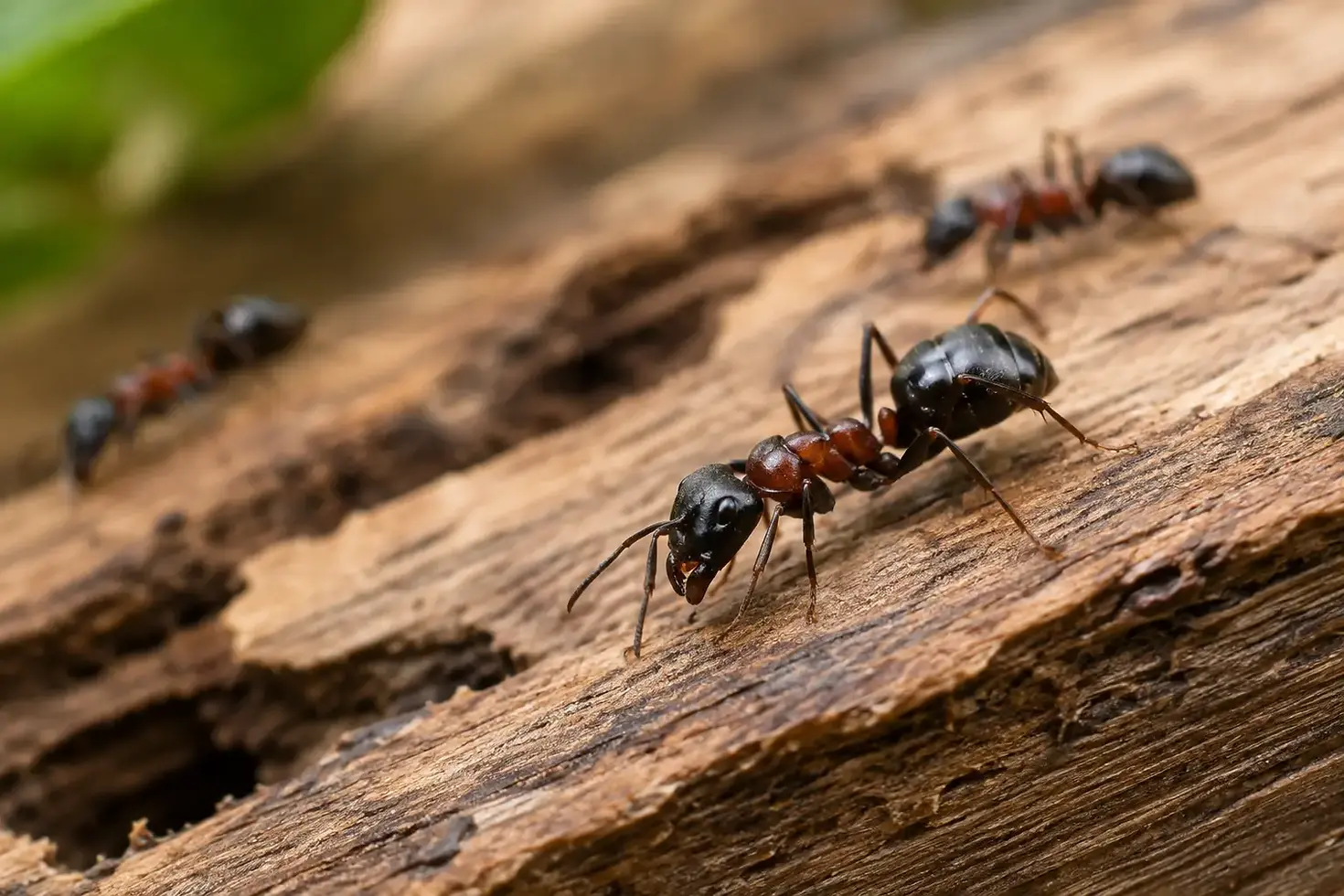
Carpenter ants are among the largest ants property owners commonly see. Workers usually range from about one-quarter inch to one-half inch long, although ants from the same colony can vary noticeably in size. A trail with both medium and large ants can still be carpenter ant activity.
Most carpenter ants in Arkansas are black, but color alone is not enough for identification. Some have reddish, brown, or dull yellowish coloring on parts of the body. Look at the overall shape instead. Carpenter ants have a rounded, evenly curved upper thorax - the middle section behind the head. Their waist has one noticeable node, and their elbowed antennae bend clearly rather than appearing straight.
This can help separate them from termites. Termites have straight-looking antennae, a thick waist, and a more uniform body shape. Carpenter ants have a narrow, pinched waist and a more defined three-part body. If you find winged insects indoors, this difference becomes especially useful.
Carpenter Ants Versus Winged Termites
Winged carpenter ants, often called swarmers, have two pairs of wings, but the front wings are longer than the rear pair. Winged termites have four wings that are roughly equal in length. Carpenter ant swarmers also keep the ant-like pinched waist and bent antennae.
Both insects can appear after warm, humid weather, especially in spring. That is why finding wings on a windowsill or near a light should not be dismissed as a seasonal nuisance. Save a few specimens in a small container or take a clear photo before cleaning them up. A professional can often identify the pest quickly from those details.
Look for the Signs Around Wood, Not Just Ant Trails
Carpenter ants prefer to nest in wood that has been softened by water, decay, or repeated moisture exposure. They may use a wet window frame, a leaking roof area, wood around a chimney, a damp crawl space, or siding near a gutter problem. Once established, they can expand into nearby sound wood as the colony grows.
Their galleries are generally smooth and clean-looking inside, almost as if they were sanded. Carpenter ants push the material they remove from their nesting areas, leaving small piles below an opening or crack. This debris can resemble coarse sawdust, but it may also contain insect parts, bits of insulation, or fragments of wood.
Do not assume every pile of wood debris means carpenter ants. Powderpost beetles, dry rot, construction work, and ordinary deterioration can leave material behind as well. The strongest evidence is a combination of debris, active ants, and damaged or moisture-prone wood in the same area.
You may also hear faint rustling inside a wall or hollow door when a large colony is disturbed. That sound alone is not proof, but it is a good reason to schedule an inspection if you have also noticed ants entering and leaving the structure.
Where Carpenter Ants Commonly Show Up
Carpenter ants can nest outdoors and travel indoors in search of food and moisture. Their outdoor nests may be in stumps, dead limbs, landscape timbers, firewood, fence posts, or woodpiles. An outdoor nest does not always mean there is an indoor infestation, but activity near the foundation is worth watching.
Inside, check areas where water and wood meet. Kitchens, bathrooms, laundry rooms, basements, crawl spaces, attics, and attached garages are common trouble spots. Watch for ants around window sills, door frames, plumbing penetrations, and areas beneath roof leaks.
At night, use a flashlight to look along baseboards, behind appliances, and near pet food or kitchen counters. Carpenter ants are often more active after dark. They may be looking for sweet foods, grease, dead insects, or moisture rather than eating the wood itself.
Do Not Rely on Size Alone
Large ants are often carpenter ants, but size can be misleading. Other ant species can be larger than expected, and some carpenter ant workers are smaller than the big individuals people associate with the species. Color can be misleading too, since black ants are common in many Arkansas yards.
A better approach is to consider the full picture: body shape, antennae, repeated activity, nearby moisture, wood debris, and any winged insects or shed wings. If you only see a few ants outside on a warm day, monitoring may be all that is needed. If they are repeatedly appearing indoors or near damaged wood, waiting can allow the colony to spread.
What to Do If You Suspect Carpenter Ants
Start by reducing the conditions that make nesting easier. Repair active leaks, keep gutters directing water away from the house, move firewood away from the foundation, and trim branches that touch the roof or siding. These steps can lower the risk, but they may not eliminate an established colony hidden in a wall, ceiling, or crawl space.
Avoid spraying random ants with an over-the-counter product and assuming the problem is solved. A surface spray may kill visible workers while leaving the nest untouched. It can also scatter activity and make the source harder to pinpoint. The right treatment depends on where the colony is nesting, whether moisture damage is present, and whether the ants are coming from outdoors or inside the structure.
For homeowners, property managers, and business owners, an inspection is the practical next step when carpenter ants are recurring indoors, emerging from a wall or window area, or appearing with damaged wood and debris. A trained technician can identify the insect, locate likely nesting conditions, and recommend treatment and prevention that fit the property.
If you are unsure whether you are seeing carpenter ants or termites, treat that uncertainty seriously rather than guessing. A clear identification gives you a better chance to protect the wood, correct the moisture issue, and move forward with confidence.